The Adventures of a Part Time Professional Gypsy (and her ginormous teddy thing)

Tuesday, September 20, 2016

Turning Bras into Pumpkins


"Are you an African?"
"How did you know?" 
"You look like one?"
"You have met many?"
"No. I have never met an African."
I smiled in confusion
"But I have read about them.They are good people."

Trying to show my new mates where Africa is...
Charles was clearly incredibly wise and insightful. 
We got talking about good people. 
We got talking about bad people 
(PNG is renowned for their rascals - the raping pillaging, lawless anarchists hungry to inflict pain and violence in their wake). 
We got talking about cannibals:

"The headman would choose who he would like to eat. Sometimes the men. Sometimes the woman. Normally visitors - especially the lumo lumo" (white men; maybe I was dark enough to avoid the palet). 
"And how would they eat them?"
"Well first they would remove the head. The body would be cooked on a fire and served to the village. When the flies stop sitting on the head then it is ready to be boiled and turned into a soup. The soup is a special delicacy."
"IS!!??" I asked in a mild panic. "What do you mean is?"
"No no no" said Charles. "We do not eat humans anymore. Now we have enough meat."
I wondered how their "meat" supply was doing with the famine and drought they'd experience just last year.
I delved deeper into the technicalities and the history on the matter and probably shouldn't have. Just one bay over there still sat a boat where all thirty [plus] passengers were dragged ashore and feasted upon  
"And how long ago was that?" 
"Ahhh, not so long ago... maybe 40 years." 
That was just short of my lifetime!


"She's half school" (one coconut short of a palm) chuckled the toothless beetlenuters who'd tied up to our boat to give us yams as another wanga [outrigger] paddled over.  
We seemed to have an endless supply of curious visitors wandering over. Sometimes we'd still be dropping anchor when the friendly smiles would bargain and trade and want. 
Day. Night. Too frequently before breakfast.


I traded 3 balloons for 2 coconuts and a bunch of tasty leaves.
I traded an old t-shirt for a bunch of bananas.
I traded beads or pens or notebooks for papayas.
Soap for wild bird eggs.
Fish hooks for potatoes.
Balloons were the first niche that all the kids wanted
In the next bay it was bracelets...
And finally i dug deep into my scant bundle of life belongings and produced luminous hairpins - they were an instant success!
We had more fresh supplies than we could eat! 
I liked this way of life. Out here money was about as useless as a roll of toilet paper that had been swimming in the bog. 


"Can you help me please, I have cut my finger" 
John climbed on board and removed his grass bandage. It didn't look like much and had already closed. We took out the first aid kit and disinfected it before covering it up with a white men bandaid. We told him he'd live.
And where are my pills?
Pain killers? 
Yes. I need painkillers.

The first visitor the next morning needed the same thing. She claimed neck pain.
"Please miss we are very remote." 
Remote? Remote? Do remote people NEED lumo lumo painkillers to survive minor pains. Aren't these the wildest of the wild- people who wrestle crocs and horde off rascals. Aren't these people genetically fearless warriors. 
I said no. And almost added a "flip off"...
She paddled away miraculously appearing to be healed.

While it wasn't everywhere, there were some islands where visiting yachts had over traded and introduced people to things that were never meant to be introduced to. When people wanted yeast or water containers, it was normally for  [illegal] homebrew.
When we tried to give swimming goggles, they simply spat them back in our face and demanded our personal dive masks instead.
Boats coming from Australia would load up with bags of donated clothes and equipment for trading, so it was hard to communicate that the t-shirt I was trading had sentimental value and was one of the only four I owned...
We didn't stick around these places for long. The residents here had seemed to forget about what was really important in life!

The local sailing canoe (Sailow)
We tried to stick to the places where we were welcomed and accepted. The places where sailows laughed as they breezed past and the smiles sang as they paddled home from their farms. 
Where the children simply wanted to give and smile and visit and play with your hair, you knew the community still held. 


"Are there crocodiles?" I asked the smiling faces who'd paddled over to greet us as we arrived after a very rough passage from Honiara, Solomon Islands.
"Yes! Plenty."
"In this bay?"
Synchronized nods.
"And do they attack?"
"Yes." [matter-of-factly as if to say "duh!"]
"Have you seen it?"
"Many times."
"And what about in your wanga? Can they jump up and pull you down?"
"Yes. Can!"


I sensed that maybe we drew so many visitors because they wanted to give us food to fatten us up and make us more attractive to the neighborhood pets.
So much for swimming. 

It was two days later on a lonely dusk [inflatable kayak] paddle back from a village where I stumbled upon a big shape drifting through the water towards me. It dropped down leaving two eye like blobs submerged and then it vanished all-together. 
I cannot confirm the nature of the creature but it separated me from the yacht and left me at a bit of a quandry: did I paddle faster and [hopefully] get back quicker? Or did I slow right down and drift in the current and wind hopefully to be mistaken as a log?

As you may have suspected I did make it back alive. 
The swarm of visitors all confirmed the nature of the creature to be as I suspected. They leave the rivers in the dry season in search of food and only return when sated.
I was glad to be home - but I saw the anguish on the faces of our guests who had a long dark row back in their dainty serving dishes.


As  we hopped beautiful islands and bays I was continually challenged to face the fears nature threw at me. I was in some of the most bewithching, unexplored  islands on earth and I was towering in fear - almost too scared to enjoy them.
The crocodiles, sharks, malarial mosquitoes, pirates and canibalisms seemed to merely mirror the inner insecurities I needed to tackle. Fear of failure, fear of inadequacy, fear of dissappointing others... These terrified me even more than the salties! It's amazing how much you learn about yourself when you completely remove all technological and worldly distractions. 


As I began wrestling the self issues, I found the natural threats becoming less alarming. I began swimming and snorkeling the pacific blues (When the kayak broke it became a necessity) and climbing hills where wild people might reside. I got myself tangled in webs and had massive tarantulas crawl over me.  We even pulled up a snake on the anchor...
I ran into a few huge reef sharks and got plenty of mosquito bites;  but I began to trust I'd be okay.
After all, I also only had one chance to explore these almost untouched cultures.

It took a long time to overcome my own inner turmoil but If I could trade my bra for a pumpkin, I could trade in my own insecurities for an unrestrained life.
I did. I think this one was a fair trade.


Tuesday, August 23, 2016

Wild People


The world is full of all sorts. It's curiously viciously grotesquely beautiful.

For most of us, we walk around with our eyes half closed and try and maintain the status quo - trying to fit into our surroundings - be just beautiful enough, just successful enough, clean and groomed enough so that we fly by life with only the right kinds of attention. We long to fit in. And if we want to be noticed, it's normally for all the wrong reasons. You probably don't believe me, but look in the mirror and tell me who you really are!?


I didn't know much about the Solomons, in fact the only thing I'd read on the country said this:

"The Solomon Islands is a melting pot of various ethnicities, and they don't always get along. One group or another is always unhappy, and they don't mind expressing it with a protest, which often turns into a riot, which sparks looting and general lawlessness... Trouble brews quickly here.

Honiara is also the crime capital of The Solomons, and wealthy-looking visitors are often a target. Leave the expensive watches and expensive jewelry at home. Don't walk around the streets alone at night (best to go with a group or a guide), and give the early morning jog a miss.

If you do go out to a bar at night, be aware there'll always be a few locals who like to fight – there were active headhunters on these islands until the 1930's, so they probably know how to handle themselves.

During the day pick pocketing, bag snatching, mobile phone theft and general harassment is common.

Yachties Beware! Foreign governments also warn their yacht-based citizens to take care in Honiara harbour where there have been reports of criminals boarding yachts at night and stealing valuables. They are usually armed and are not deterred if confronted. It's best to let them take what they want and live to tell the tale.

...Swearing is a crime. It can lead to compensation claims or jail, or both.
Homosexual acts (by either sex) are illegal and penalties include jail sentences.

Bull, Hammerhead and Tiger sharks are present throughout Solomon Islands coastal waters. The timid Reef Shark is harmless, but, unless you know the difference, be wary of all sharks.

About 50 people are killed every year by saltwater crocodiles. These are locals, well-acquainted with the ever-present danger. Unsuspecting tourists are well advised to seek advice before entering unfamiliar waters and to be wary in any case.

In and around Honiara, uncontrolled dogs roam freely, often in packs. Tourists are advised to be cautious.

Solomon Islands is part of the Pacific ‘Ring of Fire', an area of volcanic activity over 40,000 kilometres long where 90% of the world's earthquakes occur. Four active volcanoes are listed. In April 2007, a magnitude 8.0 earthquake and tsunami struck the Solomon Islands killing at least 20 people and destroying villages. The most recent earthquake occurred in the Western Province on 4 January 2010. The resultant tsunami caused significant structural damage on the islands of Tetepare and Rendova. No lives were lost.

Cyclones bring heavy rain and cause local flooding. Roads are damaged and bridges often washed away. Travelers are advised to check local weather forecasts before traveling in unfamiliar areas."

-World Nomads. Solomon Islands : Everything you Need to Know Before you Go.
(Self-highlighted in bold for emphasis)

There was also mention of tropical beaches; but you tend to remember the negatives...

I suddenly remembered why I don't normally read up on countries before I visit them... At least I had a nice ten day sail up from Fiji to masticate this information and prepare myself for what [mis]adventures lay ahead. 
I'm sure the native crocs were going to love our inflatable kayak dinghy-tender.


Photo courtesy of Manuel Sturm; S/Y Gamine
The perfect setting to contemplate your fate.

We arrived at night. A phosphorescent crocodile swam over to pilot us in to Groscious Bay, Santa Cruz. 
The jungle buzzed around us as we celebrated our arrival with a bottle of red. 
In the still of the anchorage my heart raced: Pirates... Malaria... Are we safe?


The morning bought schools of visitors in dug-out canoes. Half naked. Red beetle nut toothed. Wild! Missionaries... Fishermen... Traders. 
You can trade for just about everything in the Solomons; one college we visited encourages their students to pay tuition in dried fruit or pigs. 
They no longer accept trees. 


As we jumped islands and bays we got sucked into the beauty of the wild. The bleach blond hair of the kids. We would paddle ashore to glares and unwelcoming machete yielding stances, but without fail our greeting the various onlookers would return a ferocious toothless smiles and friendships would be struck in minutes. 


Such was the love for the Hapi Isles, that one crew member opted to plant roots; and we said goodbye to Cocotino in a very moving, well attended burial ceremony.

Raphael bidding farewell to his trustee first mate.
In Santa Ana the people still challenge each other in warrior fights where spears are flung at neighbouring tribes to prove hero status. 
There's often casualties; but the heroes live on in legend and their bones are kept as sacred reminders for future generations. 
It's a wild world out here. A beautiful one.

House of the warriors.
Woman are not allowed to look upon the bones, but the boys were nice enough to get a picture for me.
Even the capital, Honiara, and it's dusty beetle stained streets has something genuine and raw about it. The dogs don't seem to bite, and neither do the people [yet].  
It also has WiFi and real coffee and that's a plus.

What did you see in the mirror? Who looked back at you?
If you look deep inside you will find that we are in fact wild things. 
We have flames of passion and lustre for life burning inside. An inextinguishable flame. 
We too are in fact wild people.

It's funny how the men all fight and get called "The Heroes"
...But the woman are the only ones brave enough to battle intruding snakes...

Wednesday, July 27, 2016

And they will know us by the Trail of Bread...


You know that feeling you get just before you begin a new chapter??
When you hear adventure calling your name and the beckoning is so loud that you have to heed it... even though you're not quite sure where it will take you and what you will find when [if] you get there...??
When you're thrillingly terrified... And you can't sit or relax or even think for fear of what it is that is about to pounce at you??

After 9 years of incongruously traipsing this planet, I'm amazed that I still get the jitters; that exhilaration still pulses through my veins... Actually I suppose it's the bewilderment that keeps me doing this. Yes, I should have it down. I should be mentally and physically prepared and set and... this should be a walk in the park... But still the flutterbys swarm my intestines and well...


...Well yes, it's back into the vortex of sea I go... 
And this time I'll be crewing on my smallest sailing boat yet, a Beneteau First 25; which, as the name suggests, is a "mega yacht" measuring in at a whopping 25 feet (7.62 m). Mono hull.  
I'm still trying to work out my explanation for my choice of vessels (there were a plethora of bigger, flasher, faster boats to choose from and an array of kind and funny and adventurous skippers), but I've learned enough in life to follow my instincts. 
And sometimes you just know something's right. It's infinitely more important to be on the right boat with the right crew - regardless of the destination - than anything else... Boat hopping is as extreme as hitch hiking gets: There is nowhere to just hop off, it's a flipping long way before you get to refeul and replenish, and you don't get bathroom stops... 
Fortunately this time, as I reassured  my mother this morning, we actually even have a toilet aboard.

Although I still maintain that this is the world's best toilet!!!
In fact it's a pretty interesting mix of cultures aboard: The boat (Yacare) and the skipper (Raphael) are French. The first mate (Cocotino) is a young coconut tree. Then there's me, the African. And my first mate, the trusty (little bit crusty) Teddy Teddison. 
To top that we also have yogurt, wild yeast and other foody cultures we'll be cultivating and experimenting with as we continue to cross the Pacific. And, with the lack of fridge and freezer, we'll be forced to be regularly producing sour dough and fermented milk products... 
We may even leave a trail of bread crumbs for you to follow. 

You ought to be able to tell who's who in this picture...
There will be stars. And sea. And whales. And dolphins. Mermaids, and flying fish.
There will hopefully be time to read and write and draw. 
There will be French... a language I don't speak [yet].  

But here we go again... Goodbye Fiji and thank you for a flipping phenomenal time!!!

...Next stop, The Solomons [probably] with it's crocodiles and pirates and malarial mosquitoes and volcanoes... 
Yes, here we go again.
Ahhh, the excitement!!

Thursday, July 21, 2016

Namesake


I was named after my late grandmother: Dina. Man was she an epic sort... but then again, everyone in my family is.

Left to right: Epic sort, Epic sort. Epic sort. Epic sort
But I've never really given much serious thought to the whole "who am I really?" nonsence... you know, all the name meanings and heritage mumbojumbo... but maybe, yes maybe, there's something to it?? All of Fiji keep talking about their namesakes and they're pretty smart and excessively happy beings!!


Mum told me that my name meant "noble woman of esteem." I thought that sounded a bit posh and ostentatious - but I rolled with it. And then my travels led me across many an Israeli who informed me that in fact my name, apart from being an "old people name", also meant "soft and gentle". And yes, after a couple of months spent in Fiji, I am pretty soft and squishy; but gentle? I'm not so sure.

After sitting through many a gift giving (sevusevu) and grog drinking (kava: dry mildly-sedative roots mashed up and soaked into water) ceremony where my name and a lot of clapping gets thrown about almost hap-hazardly, I've come to realise three things. Firstly, I don't like kava very much. Secondly, I've got some flipping big foot prints to fill if I want to live up to my grandmother's legacy (even though she was a tiny human) and finally, I've found a more accurate depiction of who I am (although I suppose that's just my noble esteemist opinion)... In Fijian "Dina" means "true and genuine". And I'll take that!


What better person to be than who you really are?
Big, small, tall, short, funny, passionate, boring, gregarious, impulsive, bad-ass, inbred, accident-prone, cross-dressing... whatever, it doesn't matter as long as you're you!
And that's who I want to be; a true and genuine [Dina] me.

Who's your name sake? What's your name mean? What shoes were you born to fill??

Wednesday, July 13, 2016

Blown Away


You're sitting in your home and the wind starts to pick up. 
It gets stronger. Stronger. Stronger still. 
Before you know what's happening, the whole house begins to tremble and your roof gets whisked away. You cluster together as a family and run to the neighbours, but their house isn't there anymore so you keep running. The community hall... 
You find solace for a second, but the concrete starts disintegrating so you huddle together again and run for your lives. The only protection you can find is a uprooted tree. With eight of you hiding in it's roots, you know your chances are slim...


You heard there was a storm coming, so you'd battened down the shutters... Three families sit inside sipping sugary tea and eating custard tart (a national pass time). The rain's bucketing down outside, but your house is strong. You think you're safe. In an instant water comes gushing through the living room and you're in it. Struggling for breath you follow the flood, fight the currents, even though you can't swim...   


The walls are shaking and you have no idea what to do and nowhere else to go. You sit and sing and pray. You've got all generations of the family in your house and you know that at any second you could all be face to face with Saint Peter or whoever it is that controls Heaven's admission list. For hours the wind pounds on the door and roof threatening to come in. When nobody answers, it leaves, only to return again with more force. When it's finally safe to peek outside, you find you're the only house left standing...


So there I stood in Fiji, eager to explore.  I had a vague notion that I'd be meandering through a cyclone and tourist destroyed, money expecting, land of smiles and tropical beaches.  I thought a week would suffice. With all my life belongings stuffed into my backpack, the infamous bear on my side, and a friend from New Zealand, we set off to see what Fiji was all about. 


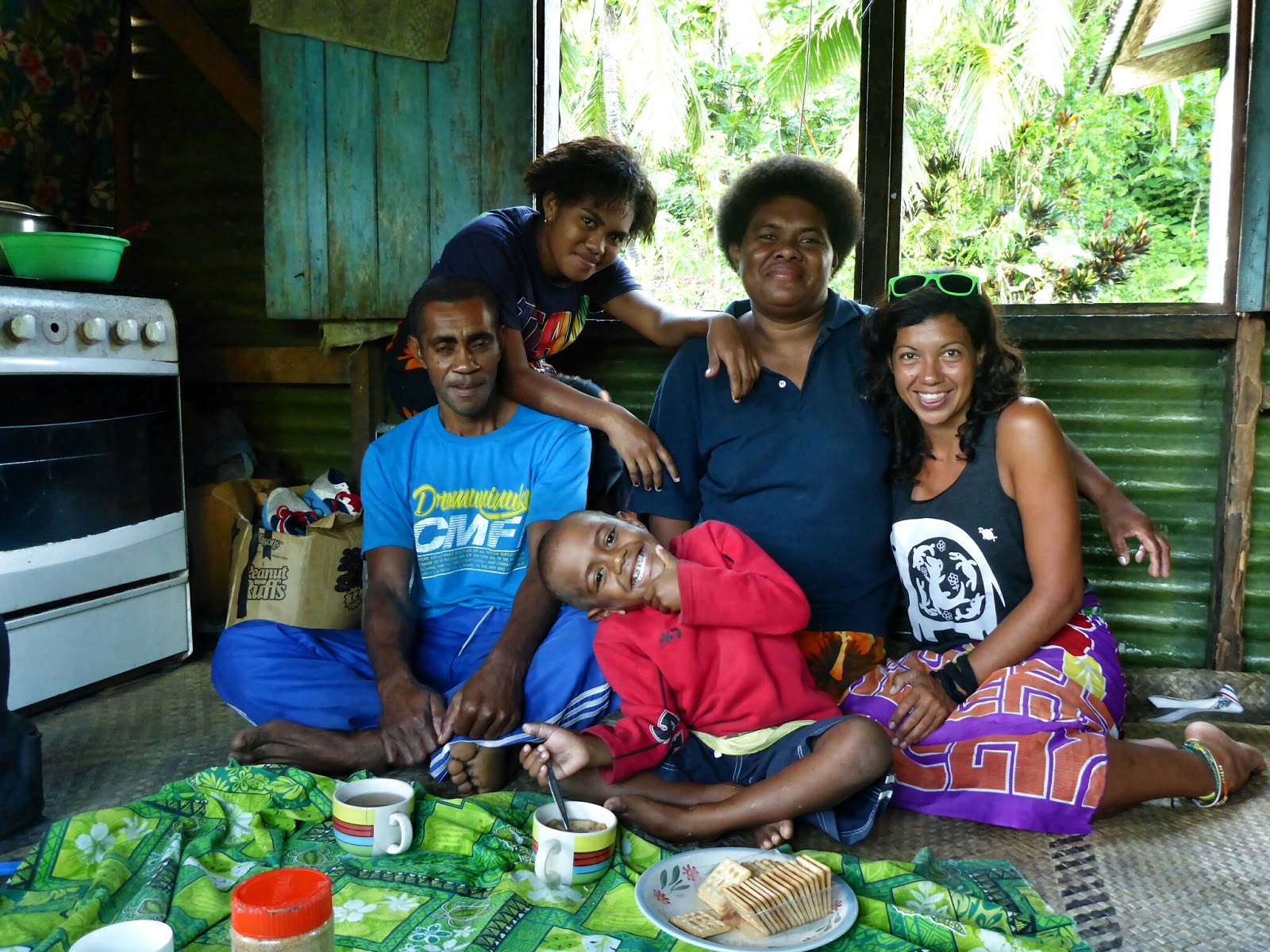
A friendly lady on a bus told us to come and see her village. We had no idea where else to go, so we did. We adorned ourselves in sulus (sarong skirts), covered our shoulders and carried our bunch of dry kava roots to the chiefs house [as is custom] where a ceremony of clapping and mumbling ensued before our sevusevu (gift) was presented and we were welcomed as villagers. We ended up living with Sara and her family for three days, being fed and catered for and blessed with so much that we felt we had to leave - we'd arrived with bags of vegetables but they gave us everything they had and wouldn't accept a thing. I'm not very good accepting anything from anyone - so we fled Vatu Lele.


Not wanting us to go astray, our exceptional hosts called up their family near Labasa and told them we were coming. We arrived with even more vegetables, and a bigger bunch of kava. Malau was tucked away between an oil refinery and a sugar plant. The kids played with whatever they found washed up on the shores (crabs, syringes, diapers...). When we arrived we were immediately treated like royalty (only instead of a red carpet, we had to make do with mats). We were living amongst the poorest of the poor and here they were lavishing us with luxuries. It was impossible to do anything without having 7 or 19 children hanging off your arm. They all wanted to be your friend. They all wanted to bring you fresh coconuts off the highest palm trees. They all wanted to make sure your daily hug quota was filled. If I went to the bathroom, they would wait patiently outside; and when I braved the shower, they'd poke their eyes through every gap in the corrugated iron walls. In the morning I'd see their shadows lurking around my tent waiting for any sign of life. They had the most beautiful voices and, with a diet of mostly sugar, more energy than the power station down the road. Again the village gave us everything and took nothing in return. Again I felt like I had to flee - my heart would burst if I had to accept any more generosity!

We worked our way to the edge of Vanua Levu (The second biggest island in Fiji)  being given more than we bargained for every jolt of the way. We began to see more and more evidence of the cyclone as we traveled East - destroyed homes, derooted palm trees, road works... and, when we ferried over to Taveuni, it was even more blatant. 


We partnered up with another friend and were trying to work out how to avoid resorts and learn more about village life as a threesome, when some friendly ice-cream licking ladies invited us to follow them home. We followed them all the way to their family reunion on a neighbouring island and for days we were fed to the point we thought we may actually burst 
(Fijian facts:
There is no limit to the amount of food a human can consume.  
The average cup of tea must contain at least three heaped table spoons of sugar.
Oil is a food group. Sugar is another. All meals must contain a 50/50 balance of the two.)
Custard Tart: a normal dinner in Fiji

One of our seven daily feasts
Using Naselesele as a base, we ventured down South, stopping to climb a volcano (which, thanks to Winston, became a 14 hour machete-a-path expedition of epic proportions) and explore beaches; constantly growing our Fijian families with people taking us in for a couple of nights and spoiling us rotten, then crying when we left - begging us to stay longer.

Climbing to Lake Tagimaucea
Just a few of the kids in Navakawau
"Should we grab some groceries first?" I asked as we clambered on yet another bus. "Nah. everything we bring gets given back to us and I'm tired of having things go off in my pack. There'll be a shop anyway..." We weren't sure where we should be going, so we asked the bus. There was a unified agreement amongst the other passengers that we should be going to Navakawau. So we did.

We arrived in the dark, and Mella, who I'd sat next to on the bus, told me to follow her. We walked through a tented camp and into her brother's home - which was reconstructed from debris to a third of its original size - and now housed two families with nine children. "Winston stole our house" she laughed. They shared their evening meal with us and poured us tea. Apart from being the worst hit village on the island (25 of 135 houses were salvageable), the chief had just died; it appeared that our timing couldn't have been any worse. 

Sat in their China-Aid tent (they wouldn't let us pitch our own tents in the dark) we cried. Here we were in the worst of the worst disaster zone, and we'd arrived empty handed. We didn't know what to do, so we escaped into the land of books.

In the morning we were taken to the [former] chief's brothers to present our sevusevu and we felt seriously sheepish. With the death of the chief, others were lavishing the village with gifts of whale bone and pigs; and here we were with a measly bunch of dry smelly roots. They accepted us anyway. We wanted to run as far away as we could, but we didn't want to offend anyone, so we decided we'd stick around for a day.    


We stayed a week. We somehow managed to stop looking at what the Fijians didn't have and instead saw what they did have. Winston stole their roofs. Winston stole their houses. Winston stole their power, their water, their family heirlooms... but Winston left them with their lives, and they knew how lucky they really were. Watching how they worked together to constrct shelters and do food preparations for the ten day funeral made me realise that Winston had actually bought them closer together.

Preparing the lunch time Casava portions
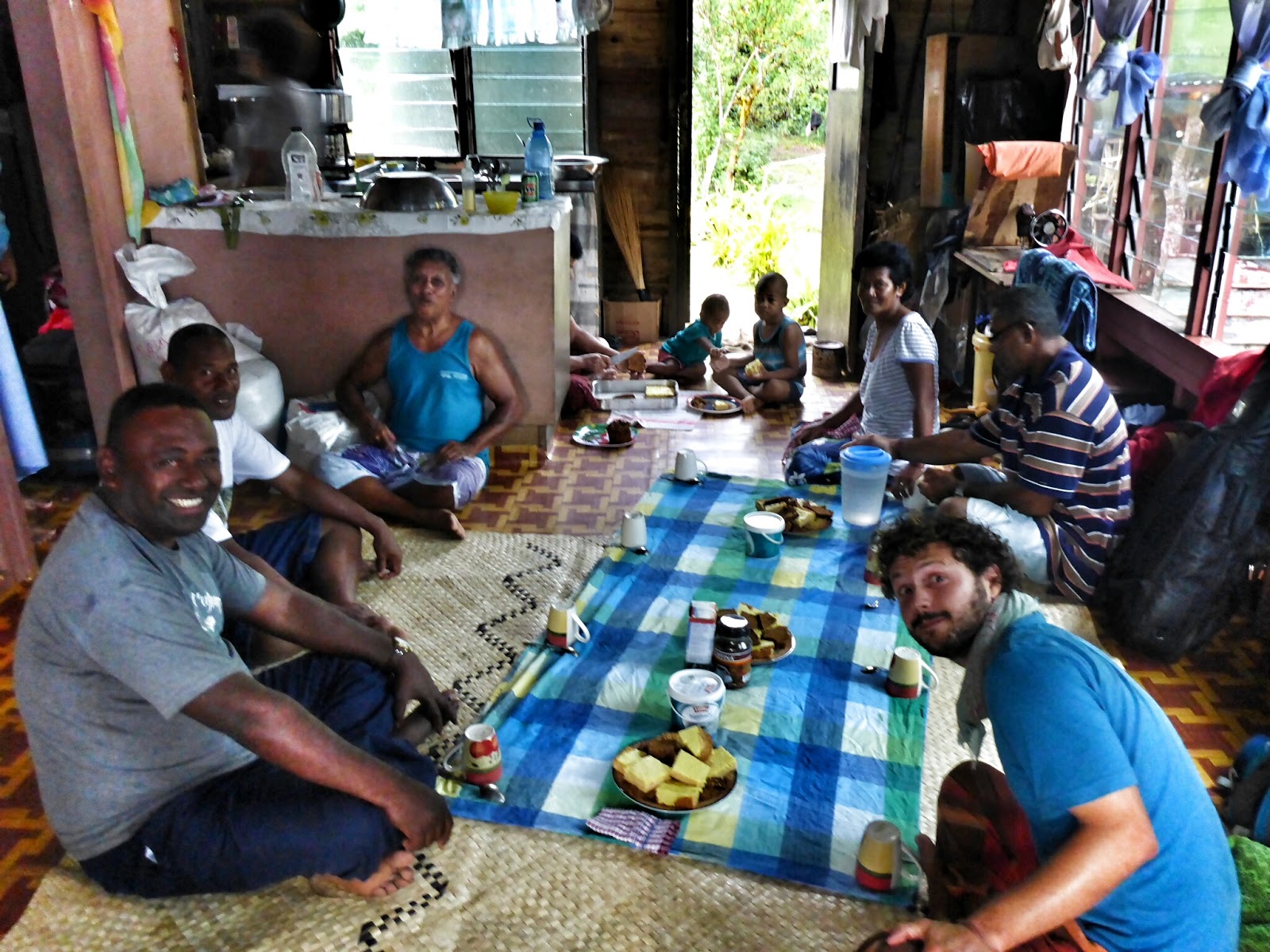
It didn't take long for us to find roles in the village. There was always something to do (whether it be construction, vegetable chopping,  or making thousands of pancakes[which I did for three days straight]). In fact, I blended in so well that most of the funeral guests spoke Fijian to me. Everyone had stories [similar to the ones above] to tell about how they had survived the cyclone. You could see why they believed in God. Everyone had something to teach, and at the same time, everyone wanted to learn what they could from us.

Funeral clothes... looking more Fijian than ever!
I left not feeling like I'd pillaged the village, but with a renewed soul and a motivated outlook to give and lavish love and to do something meaningful. I carried this with me to further islands and back to Savusavu where I met up with another old friend who was sailing out to rebuild communities with Sea Mercy... Of course I wanted to join...

Above and below: Just some of the joys of off and on-loading building materials for very remote islands.

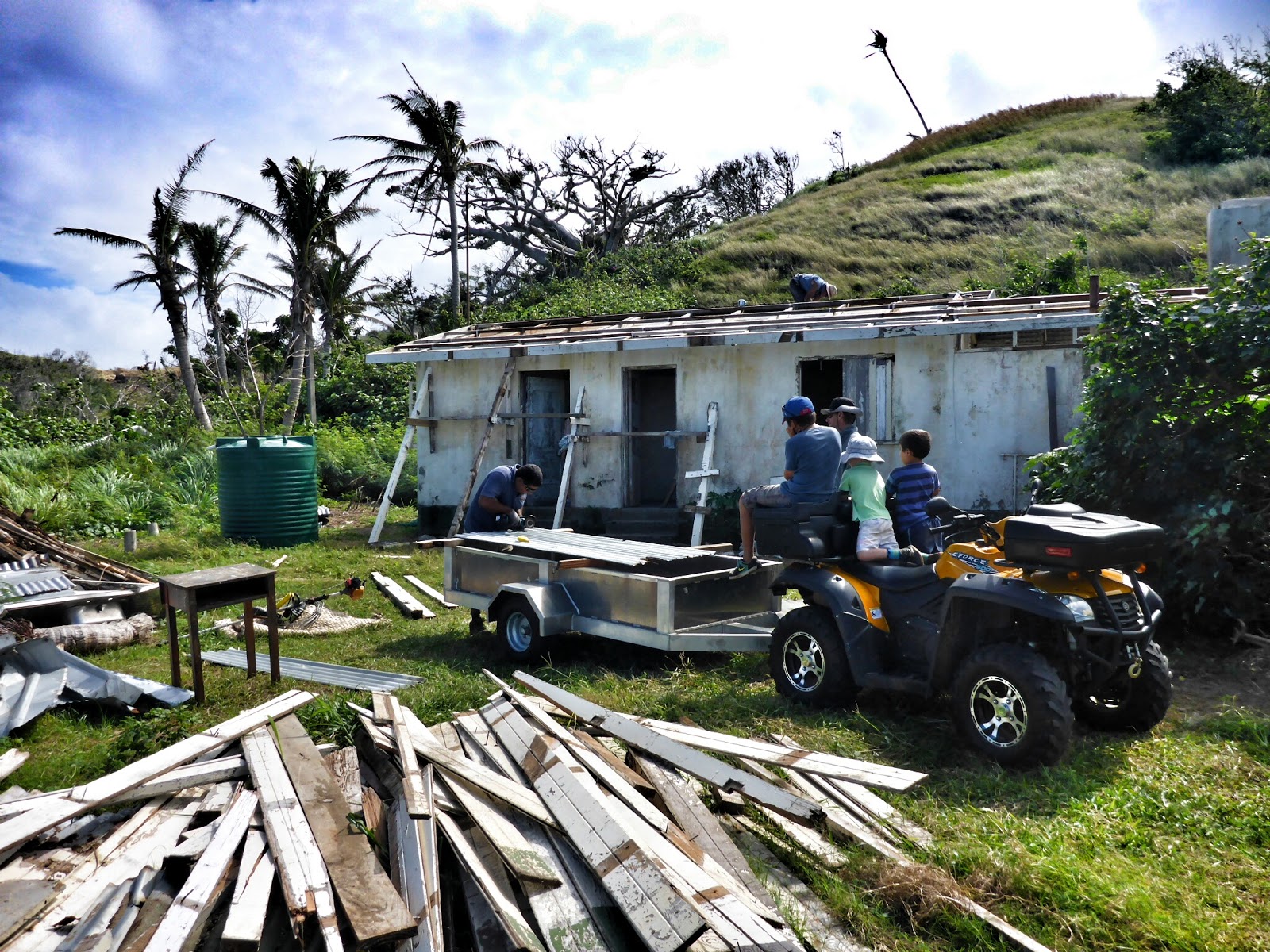
Before: The begins of salvage work on Makongai
After: The first of the rebuilt homes
Just a few of the Sea Mercy volunteers in Makogai
If you read my last blog, it was a tale about how I got lost in the world. Really I found myself in Fiji. The people are the friendliest I've ever met and the smiles are by far the biggest. The generosity of the villages has been unparalleled. But it's also been one of the most difficult countries to travel. Every stop I've made has made me look deep within and showed me things I didn't want to see. It's challenged me about my own motives. It made me learn how to accept things. It's a country that has wrestled with my heart and my soul and bought me out with a new outlook on what really is important in life.